Clawdbot, Claude Code & PI: Inside the AI Agent Revolution
In 2026, few topics are generating as much discussion among developers and technical leaders as Claude Code and Clawdbot. These AI-powered coding agents promise a future where software writes, tests, and maintains itself. But beneath the surface-level hype is a quieter, more important shift happening in how AI agents are designed.
This article explores that shift through the lens of PI, a minimal AI agent harness that challenges the assumption that more features and heavier frameworks lead to better automation. Drawing on real-world experience, advanced workflows, and current limitations, we’ll explain why minimalism—not complexity—is emerging as the winning strategy.
What Are AI Coding Agents?
An AI coding agent is not simply a chatbot that suggests code. Unlike traditional AI assistants, agents are systems that can act.
At a practical level, an AI agent combines a language model with tools that allow it to read and write files, run shell commands, fetch external data, and iterate until a task is complete. This “observe, act, reflect” loop is what enables agents to refactor codebases, automate workflows, and manage long-running tasks.
Claude Code and Clawdbot are two popular examples of this new class of software. They represent a shift from passive assistance to active execution.
Claude Code and Clawdbot: Same Category, Different Philosophies
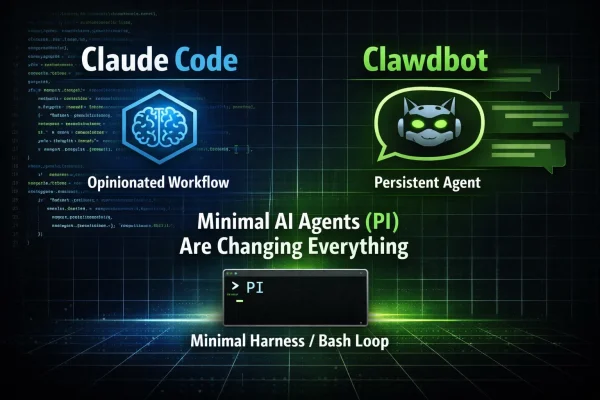
Although often mentioned together, Claude Code and Clawdbot serve different audiences and design goals.
Claude Code is Anthropic’s structured coding agent environment. It emphasizes safety-first defaults, opinionated workflows, and enterprise-friendly guardrails. Its goal is to help developers automate tasks while minimizing risk.
Clawdbot, on the other hand, is typically deployed as a persistent, conversational agent—often inside chat platforms. It maintains long-lived context, feels more autonomous, and is highly flexible. That flexibility is what makes Clawdbot powerful, but it also introduces new risks.
Despite these differences, both systems rely on the same fundamental idea: a loop that connects a language model to tools. The real question is how much structure should exist around that loop.
Introducing PI: A Minimal AI Agent Harness
PI is best described as a minimal agent harness. At its core, it is simply a loop that repeatedly calls a language model with access to a small set of tools—most notably, the filesystem and bash.
There are no complex orchestration layers, no hidden abstractions, and no rigid assumptions about how work should be done. Instead, PI is designed to be extended, modified, and even repaired by the agent itself.
This design makes PI fundamentally different from tools like Claude Code or Clawdbot. Instead of adapting to the platform, the platform adapts to the user.
Why “Bash Is All You Need” Is Not a Meme
One of the most counterintuitive insights driving modern agent design is the idea that bash is often sufficient. It acts as the primary interface between AI and the system.
Modern frontier models are heavily trained on Unix-style workflows. From the model’s perspective, the filesystem is a database, and shell commands are a universal API. Tools like grep, jq, curl, and sed compose naturally into powerful pipelines.
In practice, this means agents can dynamically generate scripts, run them, inspect results, and modify those scripts when something breaks. This approach is deterministic, inspectable, and surprisingly robust.
PI leans fully into this reality, while more opinionated platforms tend to abstract it away.
Real-World Use Cases That Go Beyond Coding Demos
The true value of AI agents becomes clear when they are applied to everyday problems rather than novelty projects.
In administrative workflows, agents can extract structured data from poorly designed PDFs, generate calendar invites, and build dashboards automatically.
In research and analytics, domain experts with limited programming experience can use agents. These agents transform spreadsheets into statistical pipelines, charts, and reports. Experts can validate results without writing procedural code.
In hardware and maker communities, agents translate physical constraints into CAD designs and 3D-printable parts.
In scraping and auditing workflows, agents detect when websites change, update scrapers, and validate outputs with minimal human intervention.
These are not hypothetical scenarios. They are already happening.
Memory in AI Agents: Useful, Risky, and Often Misunderstood
Persistent memory is one of the features that makes Clawdbot feel powerful—and human. However, memory introduces tradeoffs that are often underestimated.
From a technical perspective, memory increases context size, complicates debugging, and can degrade performance over time. From a human perspective, it creates emotional expectations that machines are not equipped to meet.
Many experienced users now favor explicit, file-based memory strategies: compressed summaries, append-only logs, and searchable records accessed via bash. For coding agents in particular, the codebase itself remains the most reliable source of truth.
Security and Prompt Injection: The Unsolved Problem
AI agents are powerful because they can take action. That same capability makes them dangerous.
Prompt injection remains a fundamental unsolved problem. Agents cannot reliably distinguish between user intent, system instructions, third-party content, and malicious input embedded in data.
A single compromised source—such as a webpage or document—can trick an agent into performing unintended actions. These actions can include data exfiltration or persistent unauthorized access.
While tools like Claude Code attempt to mitigate these risks with guardrails, no current system offers complete protection. Responsible use still requires isolation, least-privilege access, and human oversight.
PI vs Claude Code vs Clawdbot
When compared directly, the differences become clear.
Claude Code prioritizes safety and structure. Clawdbot prioritizes flexibility and persistence. PI prioritizes transparency, composability, and user control.
PI’s minimal core allows agents to modify their own tools, hot-reload extensions, and evolve workflows organically. This self-modifying capability is where many experts believe the future of agent systems lies.
Why Minimalism Wins in the Long Term
As AI agents grow more capable, complexity becomes a liability. Heavy frameworks obscure behavior, limit adaptability, and make failures harder to diagnose.
Minimal agent harnesses like PI expose the mechanics instead of hiding them. They treat scripts, files, and tools as first-class components. This approach aligns with how experienced engineers already think about systems.
Minimalism does not reduce power—it reflects confidence in the underlying primitives.
Conclusion: Power Without Illusions
Claude Code and Clawdbot have helped bring AI agents into the mainstream. They demonstrate what is possible when language models are allowed to act.
PI shows what happens when those capabilities are stripped down to their essentials and handed back to the user.
We are entering a new era of software—one defined by agents that act, adapt, and evolve. Understanding how these systems work, where they break, and how to control them is no longer optional.
The future of AI agents will not be decided by the flashiest interface, but by the simplest systems that can safely and transparently do real work.